
Semi-finished products for the metal roofing industry

Safety of structures and stored goods

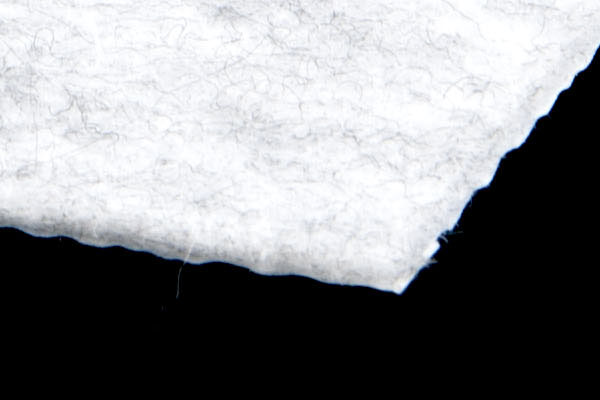
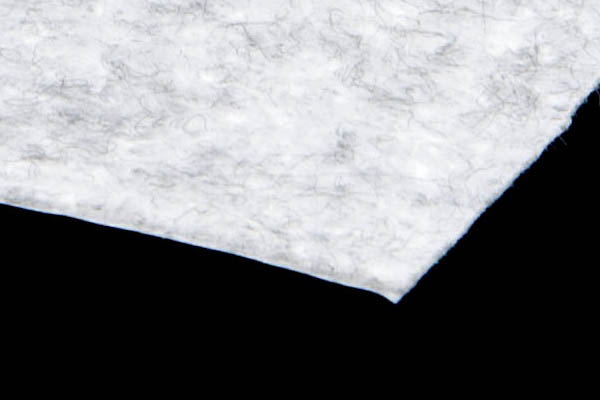
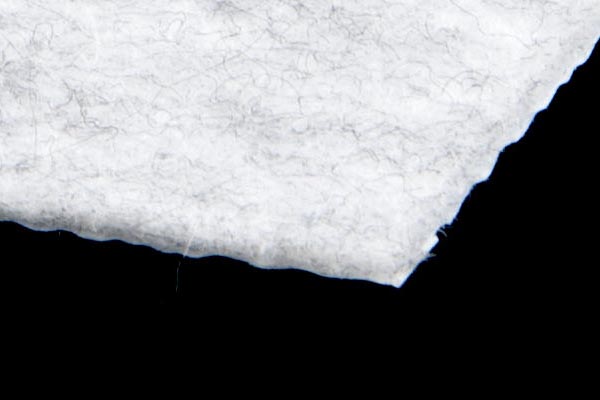
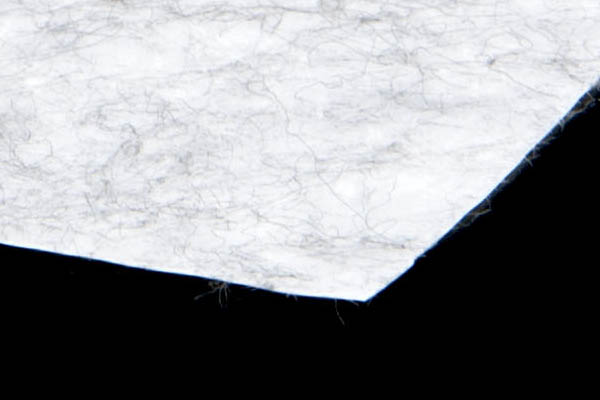
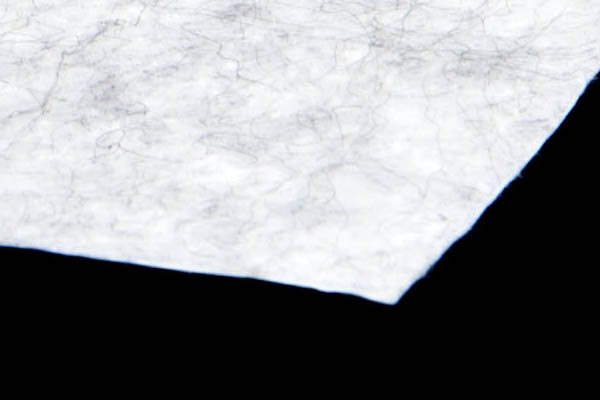
Anti•Drop is a self-adhesive membrane applied to the underside of the roofing sheet during the profiling process. As a result, the product arrives at the construction site as a ready-to-install roofing component. The material is resistant to aging and provides an extra protective layer for metal roofing. The offer includes variants with basis weights of 75, 95, 110, and 140 g/m², as well as a specialized acoustic barrier at 200 g/m².

Roof condensation – A structural challenge

Condensation on metal roofs is a silent threat. Each condensation cycle weakens the structure, increases maintenance costs, and exposes occupants to mold and moisture.

Moisture under the roof
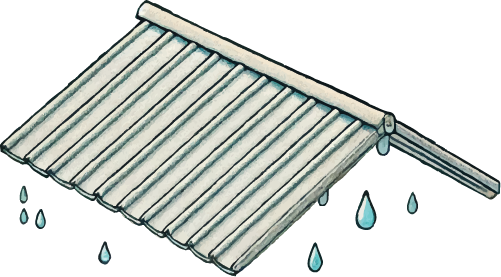
Problem skraplania wody i kapania kondensatu na urządzenia oraz magazynowane produkty przy braku izolacji dachu.

Lack of insulation and ventilation causes condensation to drip onto equipment and stored goods.

Material degradation
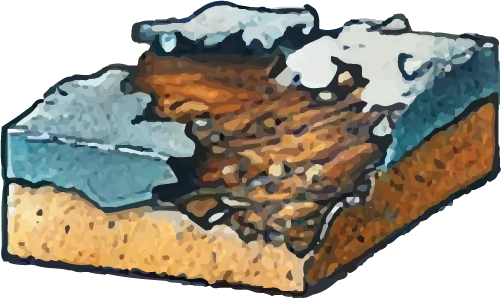
Korozja metalu oraz niszczenie drewnianej konstrukcji dachu wywołane cykliczną kondensacją wilgoci.

Condensation cycles lead to faster rusting and damage to wooden structures.

Impact on operations
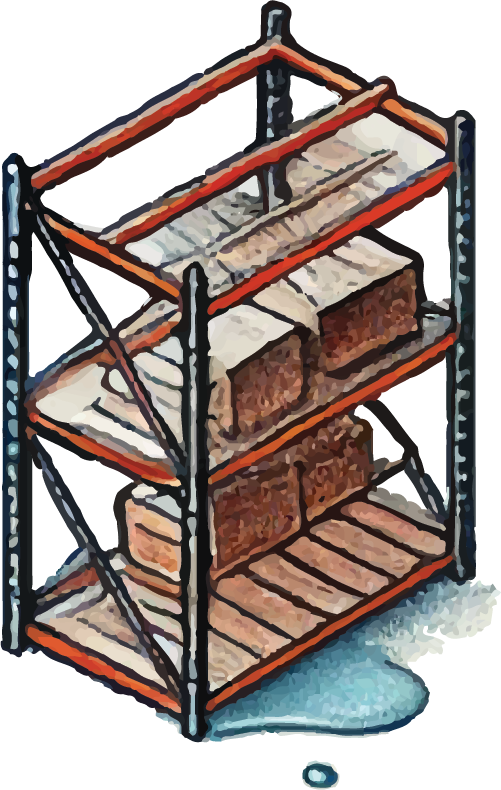
Ryzyko rozwoju pleśni, zagrożenia zdrowotne oraz uszkodzenie konstrukcji budowlanej przez brak bariery antykondensacyjnej.

Higher costs, risk of structural damage, and health hazards from mold.

Dew point – The safety boundary

The dew point marks the temperature at which water vapor begins to condense. Once the air temperature drops below this threshold, condensation becomes inevitable and poses a direct threat to the building’s structure.

Definition
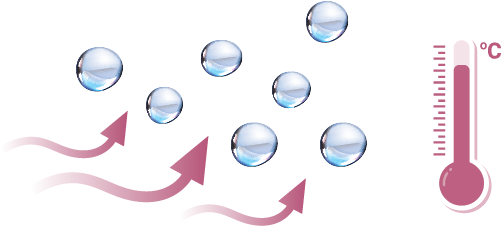
The temperature at which air becomes saturated with water vapor, triggering condensation.

Critical threshold
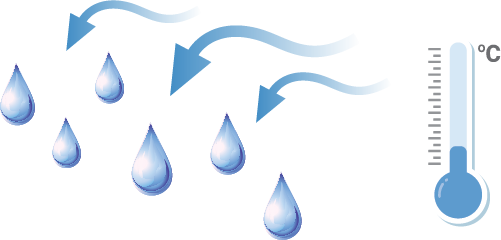
Below this point, water vapor turns into liquid droplets on surfaces.

Structural risk

Constant moisture under the roof destroys insulation, promotes mold growth, and accelerates corrosion.

Our solution – The ANTI•DROP Barrier

With ANTI•DROP, water does not drip onto equipment or goods—it is held within the membrane and evaporates naturally, protecting the roof for decades.
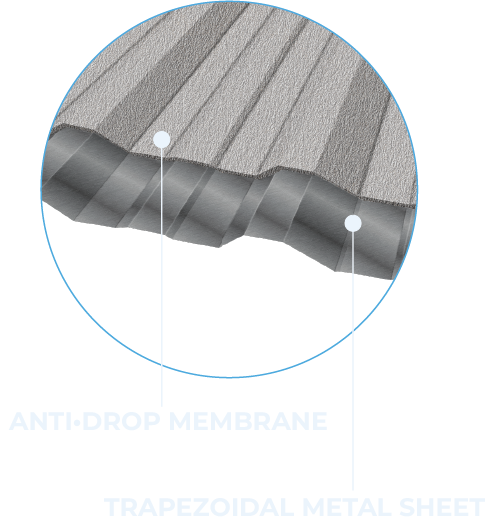
Self-adhesive membrane

Applied to the underside of roof panels during manufacturing—ready for installation.

Material protection

Isolates the metal from water, effectively reducing corrosion.
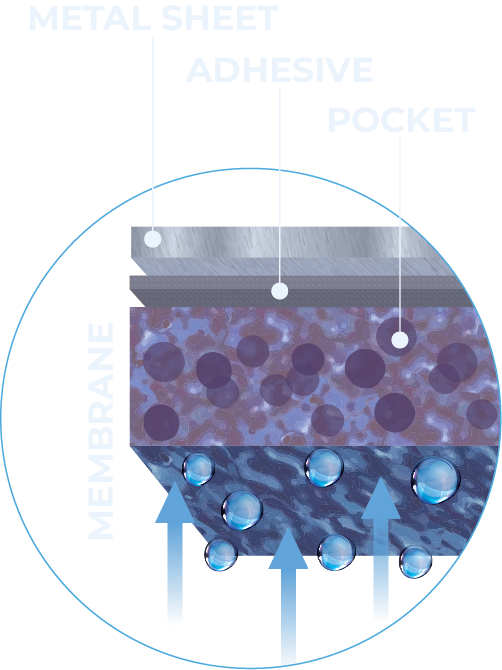
Moisture absorption

Condensation is trapped inside the membrane’s structure, not on its surface.

Safe evaporation

Moisture evaporates back into the air when conditions favorable to condensation pass.

Usage Guidelines

Capillarity

Anti•Drop stores and transports water via capillary action. To prevent capillary draw, the Anti•Drop barrier should not be adhered to the metal roof at panel overlaps or at the end of the last panel near the gutter.

Ventilation

For Anti•Drop to function properly, the building must be adequately ventilated. Fresh air should enter from the sides, while warm, humid air should exit from the highest point of the building.

Cleaning

Cleaning the Anti•Drop barrier with water is recommended—ideally using a hose or pressure washer. Maintain a distance of at least 1 meter between the pressure washer and the surface.

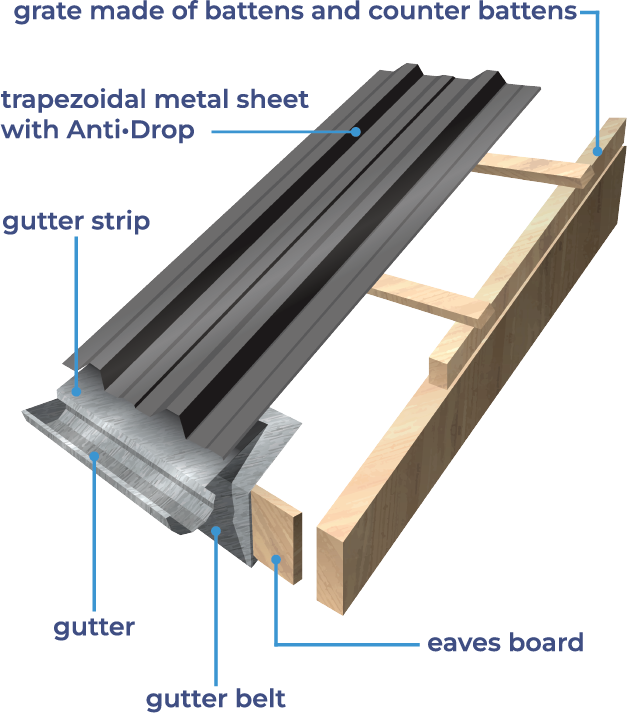
Eaves and gutter integration

Role of the eaves

Directs water away from the walls.

Drip edge (Eaves flashing)

Channels water directly into the drainage system.

Integration

Ensures maximum efficiency of the entire system.
Screws and installation methods

Proper fastening

Screws installed perpendicular to the battens.

Sealing

Rubber washers protect against leaks.

Durability

Solid fastening guarantees overall stability.

Turning a problem into an advantage

Why ANTI•DROP wins

ANTI•DROP is more than an anti-condensation barrier—it is a strategic investment. By combining technical protection with financial benefits, it turns moisture control into real value. For manufacturers, contractors, and end-users, it delivers exactly what the market demands: durability, efficiency, and a competitive edge.
Comprehensive protection

Shields the roof from moisture, corrosion, and material decay.

Lower operational costs

Reduces repairs, replacements, and energy loss.

Extended roof lifespan

Guarantees long-term durability and structural reliability.

Creating a market advantage

Gives construction companies and manufacturers a clear edge over competitors.

Products

Setting the standards

Laboratory and quality control

Lama places a strong emphasis on the reliability of its solutions. The cornerstone of our manufacturing process is an in-house, state-of-the-art laboratory

Every batch of material undergoes rigorous physicochemical analysis.

Meticulous quality control guarantees that every product leaving the factory meets the highest technical standards.

Logotyp i oznaczenia certyfikatów ISO 9001, ISO 14001 oraz ISO 45001 potwierdzające normy jakości, środowiskowe i BHP w firmie LAMA.

Certificates

Proven reliability in demanding projects.

Quality Management

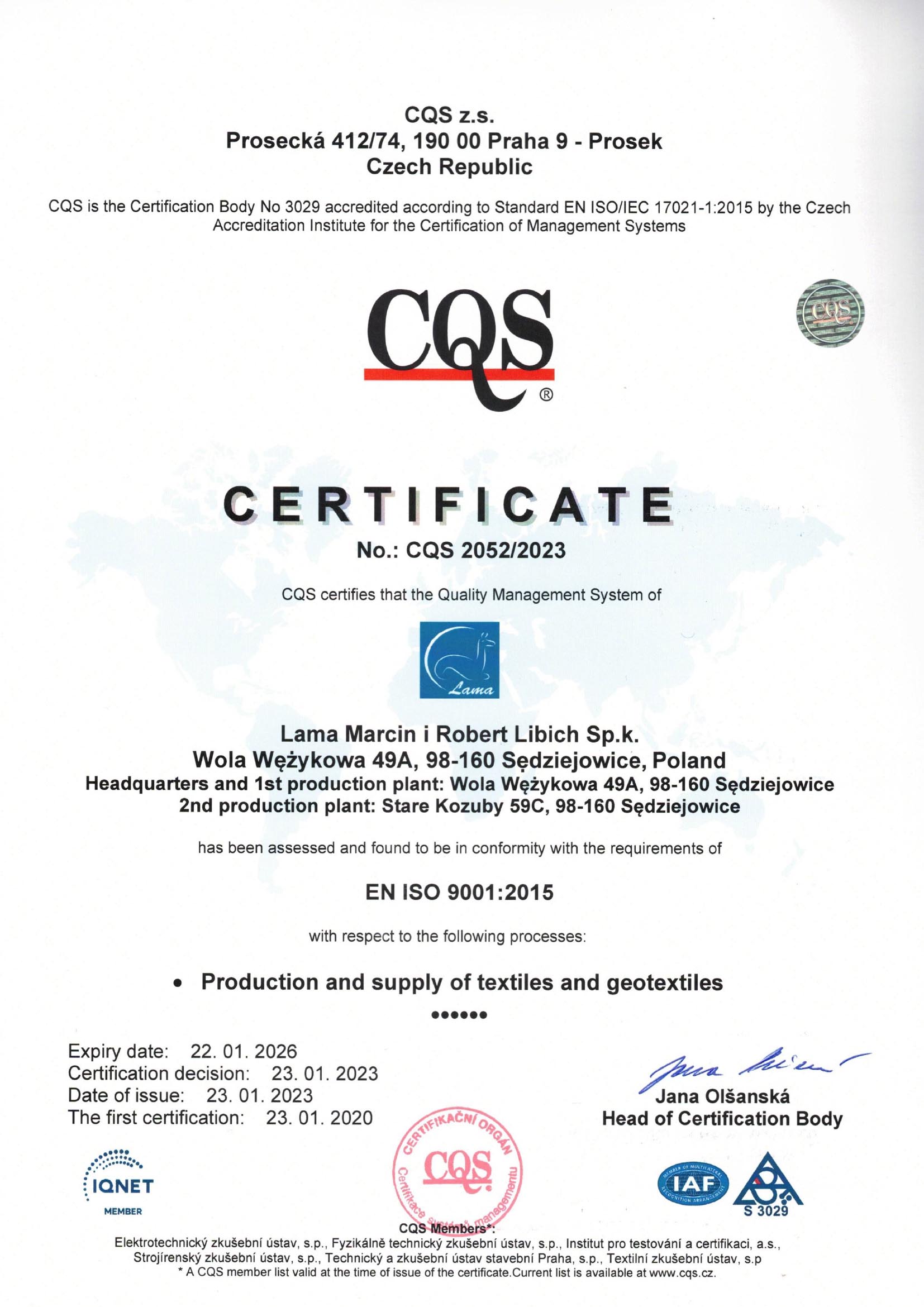
A guarantee of the highest quality and product consistency. The implemented ISO 9001 system ensures that our manufacturing processes are strictly monitored, delivering materials with stable technical parameters that strictly comply with declarations of performance.
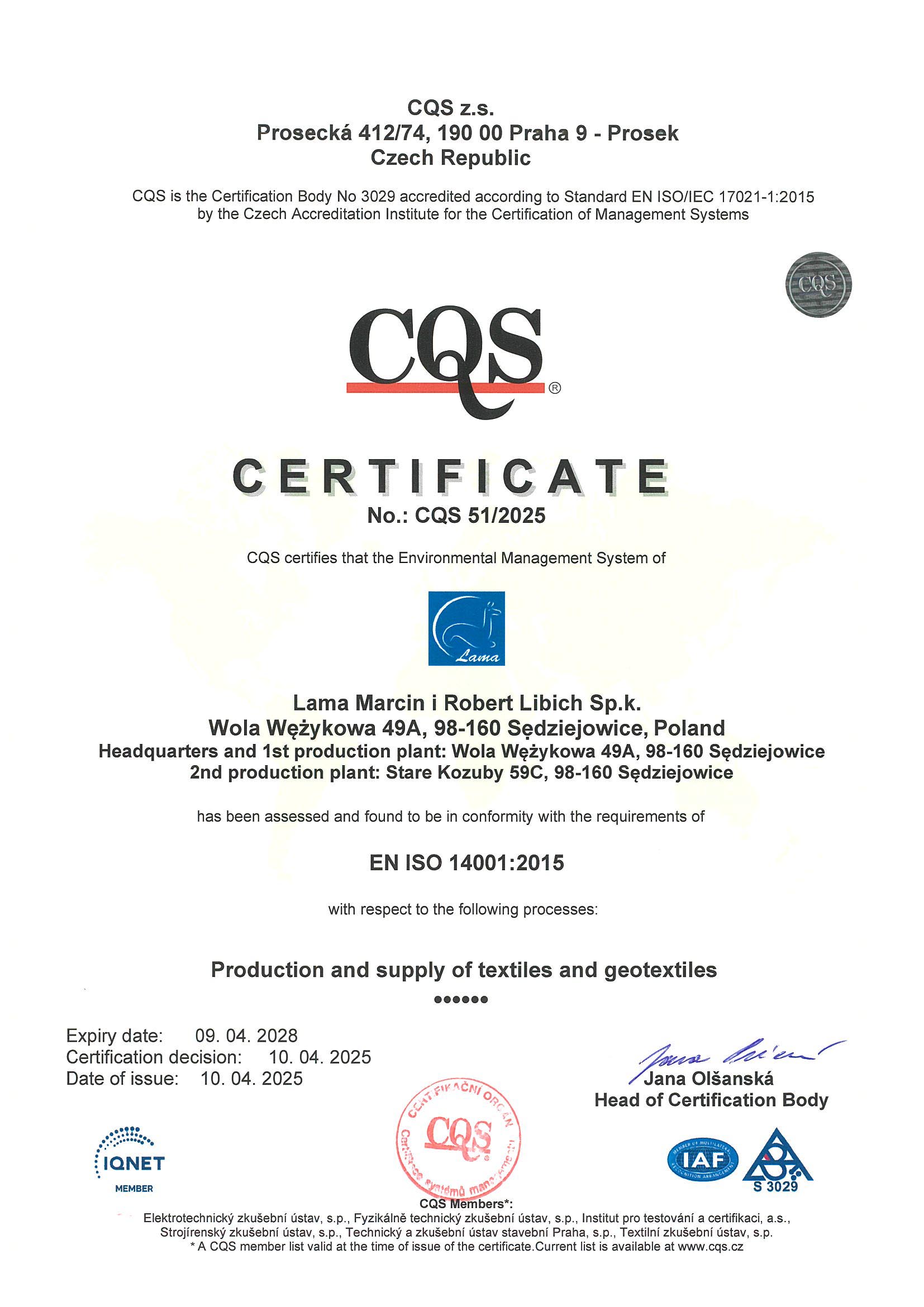
Environmental Management

Responsibility for the natural environment. The ISO 14001 certificate demonstrates our commitment to minimizing the environmental impact of our production. We optimize raw material usage and waste management to support sustainable development in construction projects.
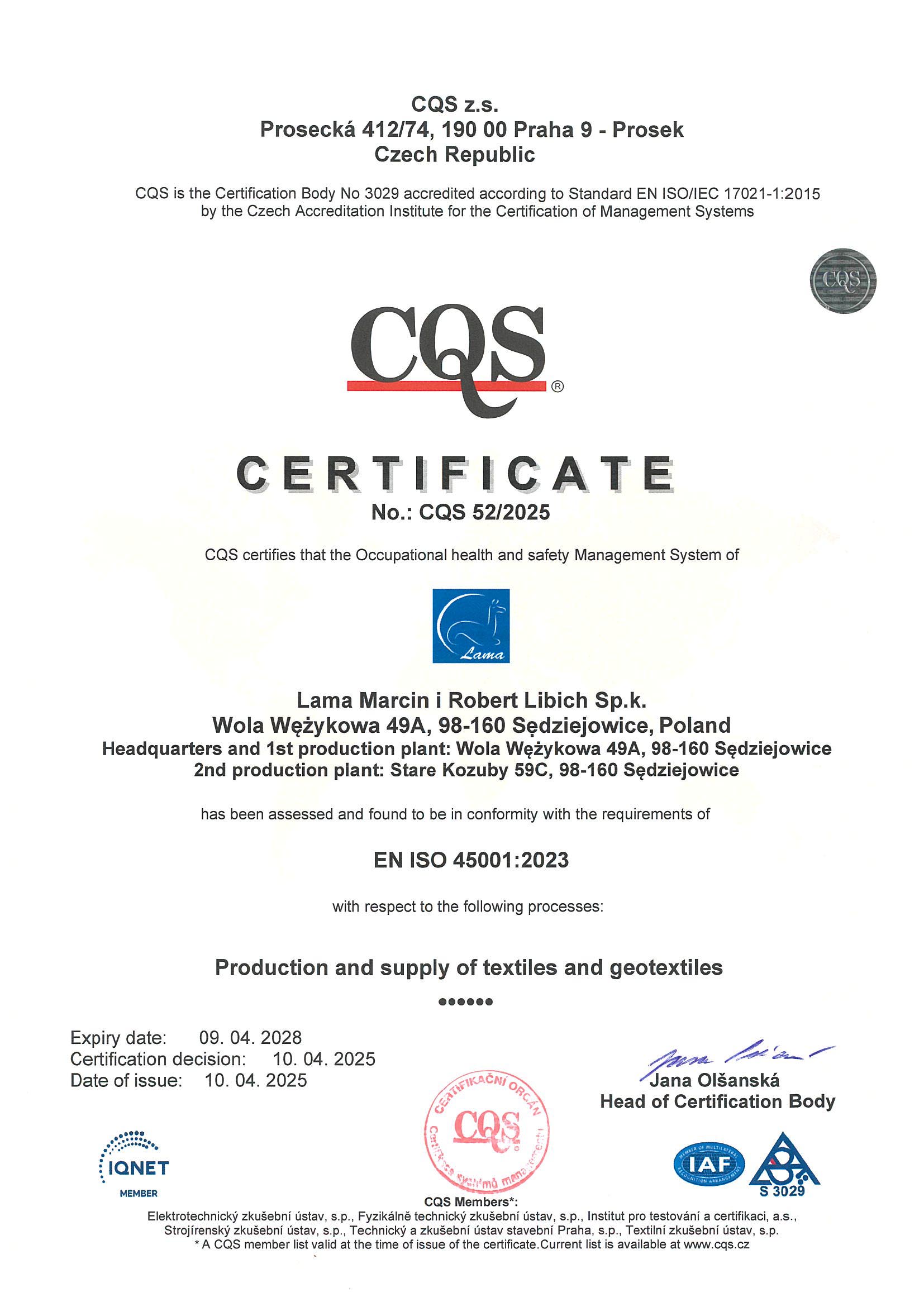
Occupational Health and Safety

The highest standards of workplace safety. The safety of our workforce directly translates into supply stability. The ISO 45001 standard validates our professional risk management and strong safety culture across every manufacturing process.

FAQ

  • Following proper installation guidelines for Anti•Drop barriers at sheet overlap locations is essential to prevent capillary action—the drawing of water through the nonwoven fiber structure—which could otherwise lead to leaks and corrosion.

    Detailed guidelines for different connection types are outlined below:

    • 1. Longitudinal (side) overlapsTo prevent moisture draw at side joints, the following rules must be observed:
      • Uncoated margins: The Anti•Drop membrane must not be adhered to the metal sheet in areas where panels overlap.
      • Roll width: The width of the barrier roll should be a few centimeters narrower than the metal sheet width, leaving a bare metal strip along the edges directly during the profiling/production process.
    • 2. End (transverse) overlapsTransverse joints require additional preparation to break the continuity of the nonwoven fabric:
      • Free space: A 5–10 cm strip of bare metal surface (without the barrier) must be left at the overlap area and at the end of the last panel near the gutter.
      • Thermal method: It is recommended to separate or remove a section of the barrier using an electric heat gun or gas burner to melt the fibers and block water transport.
      • Exception: If the transverse panel overlap exceeds 200 mm, removing the Anti•Drop barrier is not required.
    • 3. Eaves and gutter terminationsAt the ends of the roof panels, particularly near the gutter, one of the following edge protection methods must be applied:
      • Heat sealing (singeing): Melting the felt along a 50–100 mm length of the sheet using a burner.
      • Varnishing: Painting the last 50 mm of the barrier with a water-based varnish, which seals the edge upon drying.
      • Automated method: Using specialized applicators that allow for precise cutting and gluing of the membrane while maintaining the correct margins.

    Executing these edge treatments properly is essential for the effective performance of the entire anti-condensation system. Care must be taken during thermal application to avoid damaging the protective coating of the metal sheet.

  • For Anti•Drop anti-condensation barriers to function properly and effectively protect the building, ensuring balanced airflow is critical to enable the membrane to dry. Ventilation acts as a vital partner to the condensation control system, guaranteeing its efficiency and longevity.

    Building ventilation requirements include the following guidelines:

    • Fresh air intake: Fresh air must be supplied through the lower side openings of the building.
    • Warm and humid air exhaust: Moisture-saturated air should find its exit at the highest point of the building.
    • System balance: Proper circulation prevents the barrier from becoming overly saturated with moisture. This is essential for water trapped in the micro-pockets to freely evaporate into the ambient air when conditions drop below the dew point.
    • Under-roof ventilation: For the Anti•Drop 140 Drain product, proper ventilation directly beneath the roof covering is explicitly emphasized to enable effective water drainage.
    • Compliance with standards: Applicable building codes and ventilation design principles must be strictly followed during roof installation with the barrier to avoid capillary action issues and ensure full system functionality.

    Lack of adequate ventilation can cause the barrier to remain permanently wet, preventing its operational cycle (absorption – evaporation) and risking damage to the structure.